Sagrada Família
Gaudí’s extraordinary basilica—and the landmark that came to define his life’s work.
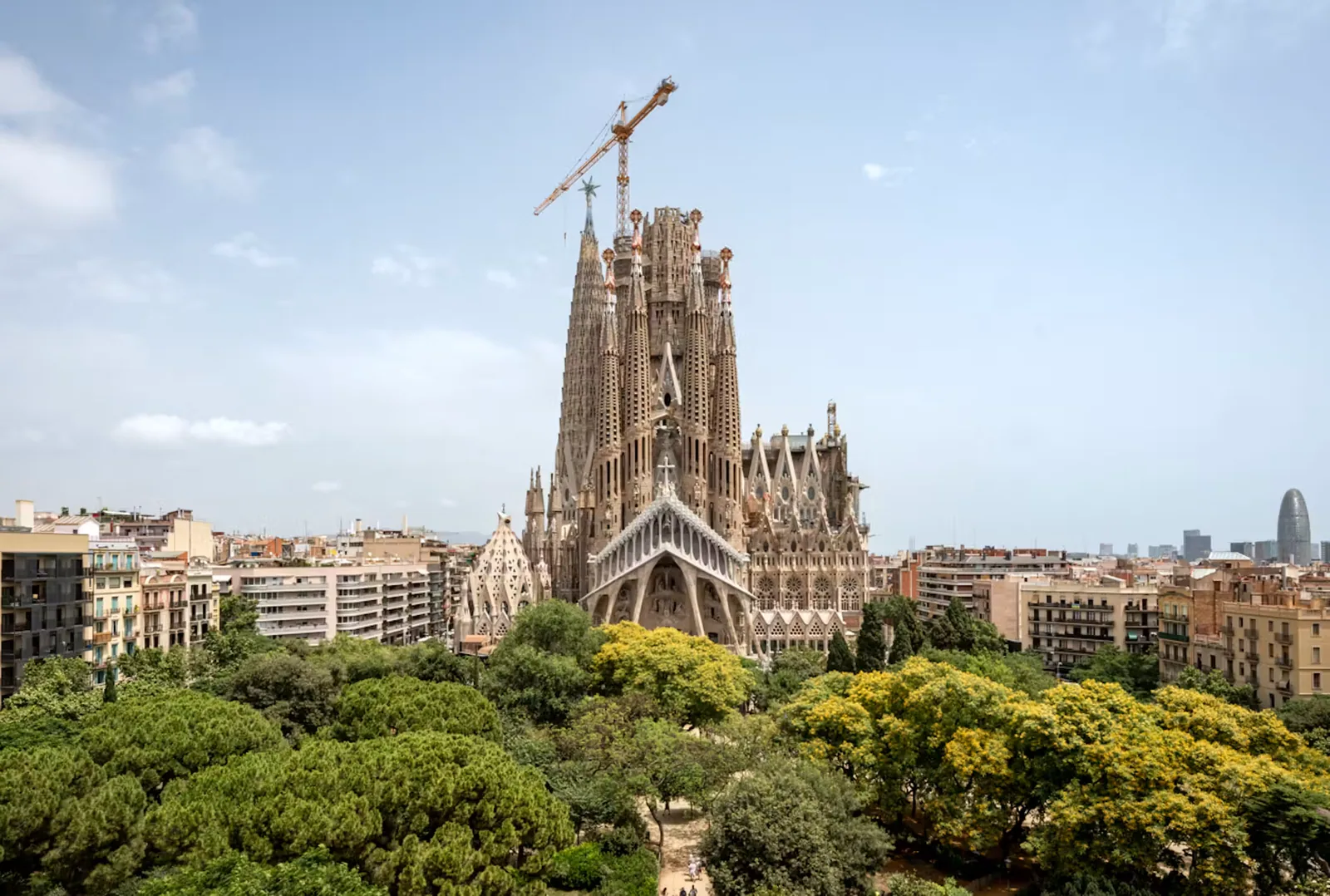
From the street, Sagrada Família is a city-sized work in progress. Inside, stone columns branch into a luminous forest and coloured glass changes the mood with the sun. This guide helps you understand what makes the basilica unmissable—and plan enough time to truly experience it.
Sagrada Família at a glance
- Location
- Carrer Mallorca, 401 · Barcelona
- Area
- Eixample
- Recommended visit
- 1.5–2 hours
- Advance booking
- Strongly recommended for timed entry
- Metro
- Sagrada Família · L2 and L5
- Gaudí involved
- From 1883
- Tickets
- Advance booking recommended — View ticket options ↓
- Opening hours
- Seasonal — View opening hours ↓
About Sagrada Família
The Basílica de la Sagrada Família is an expiatory church whose construction has historically been supported by donations and visitor contributions. Work began in 1882 under architect Francisco de Paula del Villar. Antoni Gaudí took charge the following year and transformed a conventional neo-Gothic proposal into a radically different vision.
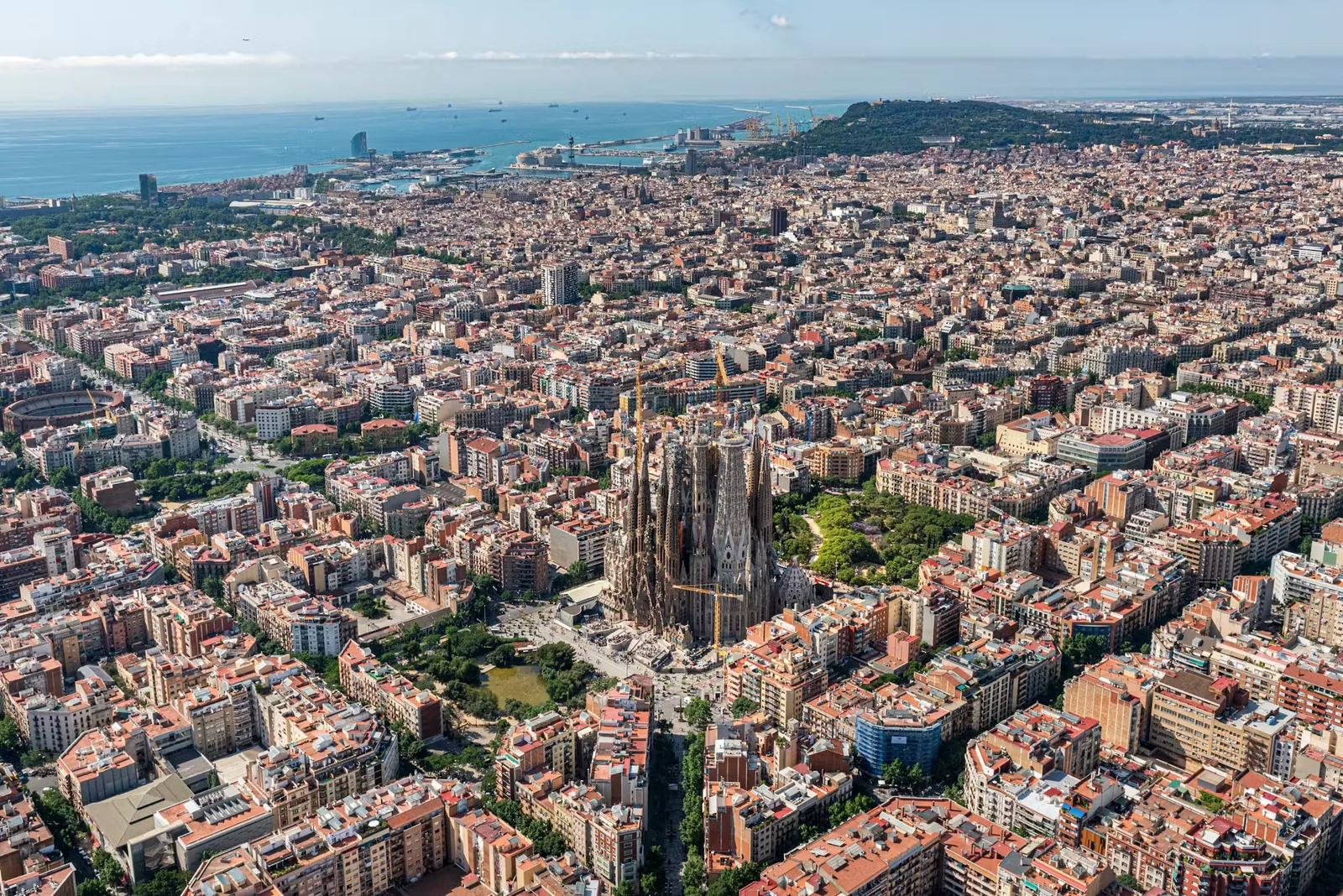
For visitors, its importance is not simply scale. Sagrada Família gathers the central ideas of Gaudí’s career in one place: structure inspired by natural growth, geometry that distributes weight efficiently, architecture shaped by light and a symbolic programme that extends from the façades to the towers and interior.
It remains an active basilica as well as a major visitor attraction. That combination matters: approach the interior as a place designed for worship and contemplation, even when the building is busy.
The history of Sagrada Família
The foundation stone was laid in 1882 for Villar’s neo-Gothic church. When Gaudí inherited the project in 1883, construction of the crypt was already underway. He completed that early phase, then used new donations to expand the ambition of the design far beyond the original scheme.
Work on the Nativity Façade began in the 1890s. Gaudí chose to develop this richly modelled eastern side first because it could communicate the promise and vitality of Christ’s birth—and because a completed façade would show future generations how he wanted architecture, sculpture and symbolism to work together.
From 1914, Gaudí devoted himself exclusively to Sagrada Família. He worked through drawings, full-scale studies and complex plaster models, leaving a method that later architects could interpret rather than a simple set of construction documents. When he died in 1926, only one Nativity bell tower had been completed. He was buried in the basilica’s crypt.
The project survived a devastating break during the Spanish Civil War, when Gaudí’s workshop was attacked and plans and models were damaged or destroyed. Later teams reconstructed surviving material and continued the work. The Nativity Façade and crypt became part of UNESCO’s Works of Antoni Gaudí World Heritage listing in 2005, and the church was consecrated as a basilica in 2010. Construction continues across generations.
Is Sagrada Família finished?
No—not completely. In February 2026, the final piece of the cross completed the exterior of the Tower of Jesus Christ. At 172.5 metres, it is the basilica’s tallest tower and brought Sagrada Família to its highest point. On 10 June 2026, the centenary of Antoni Gaudí’s death, the tower was blessed and inaugurated.
That historic milestone did not complete the entire basilica. Work continues inside the central tower and on other parts of the project, including the Glory Façade. Visitors are seeing Gaudí’s vision closer to completion than ever, but Sagrada Família remains an active construction project.
Gaudí and Sagrada Família
Sagrada Família became the great laboratory of Gaudí’s later life. He replaced the need for conventional flying buttresses with a branching structural system: columns divide as they rise, directing forces through the building while opening the nave to light. The result feels organic, but it is governed by careful geometry.
Nature was not copied as surface decoration. Gaudí studied how trunks branch, how shells curve and how gravity shapes hanging chains. He translated those principles into columns, vaults and ruled surfaces that could be tested in models. Structure, symbolism and atmosphere were conceived together.
The basilica was also Gaudí’s most complete religious statement. Its three principal façades address the Nativity, Passion and Glory of Christ, while the planned towers represent the apostles, evangelists, the Virgin Mary and Jesus. You do not need to share Gaudí’s faith to recognise how thoroughly belief shaped the building—but understanding that purpose makes the architecture more legible.
To place the basilica within the architect’s wider life and work, read our guide to Antoni Gaudí.
What to see at Sagrada Família
Walk around the entire building as well as through it. The sharp contrast between the two completed façades is as important as the famous interior.
The Nativity Façade
Begin on Carrer de la Marina and step back before looking at individual sculptures. This is the façade most directly connected to Gaudí’s lifetime. Its dense scenes celebrate birth, nature and abundance: plants, animals, figures and textured stone seem to grow across the surface. The façade and crypt are the parts of Sagrada Família included in UNESCO’s Works of Antoni Gaudí listing.
The Passion Façade
Walk around to Carrer de Sardenya for a deliberate change of tone. Gaudí conceived a severe, exposed façade for the suffering and death of Christ. The angular sculpture created by Josep Maria Subirachs decades later refuses to imitate the Nativity side. Read the scenes from lower left in an ascending S-shaped route, then look at how the slanting columns make the whole façade feel tense and skeletal.
The interior
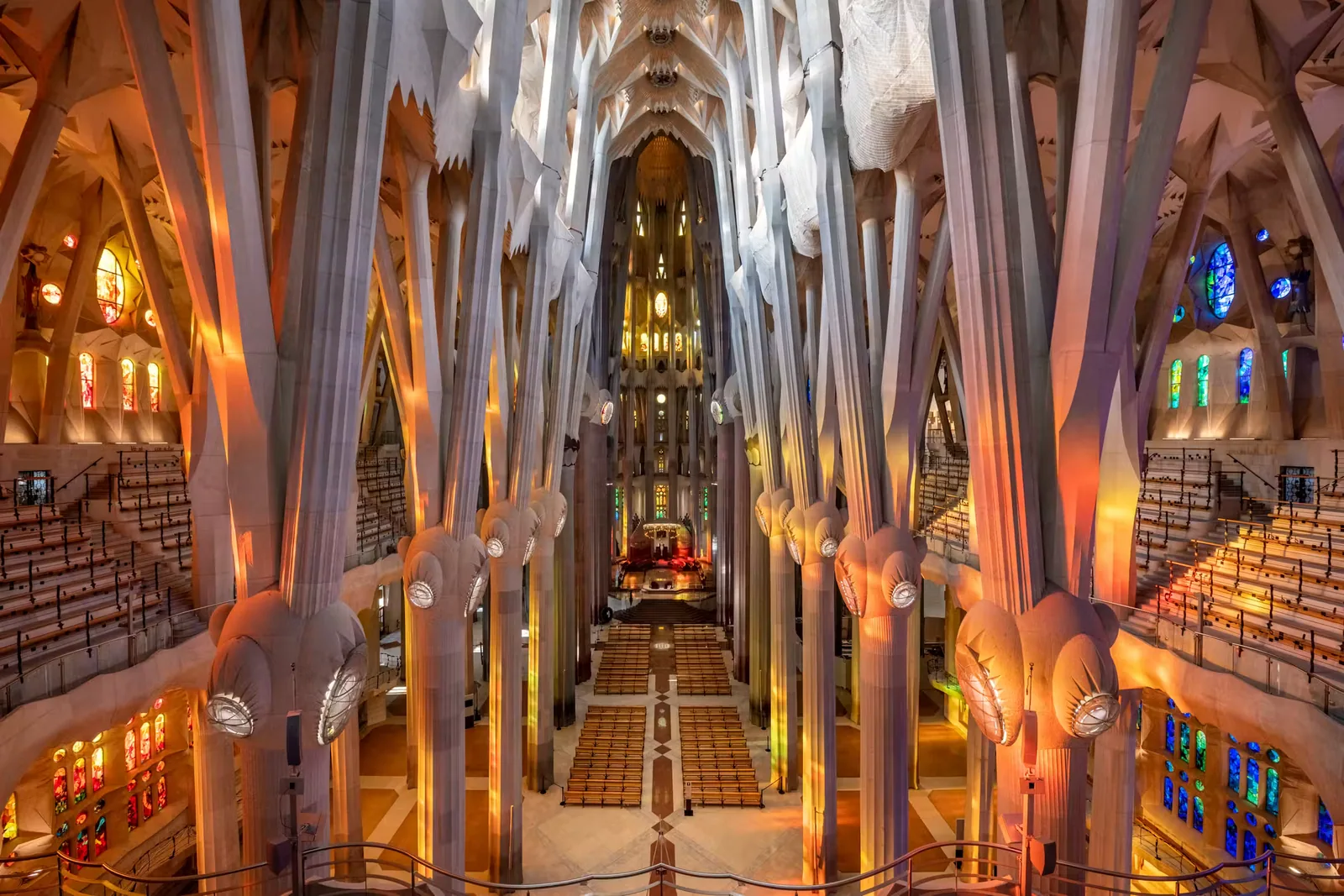
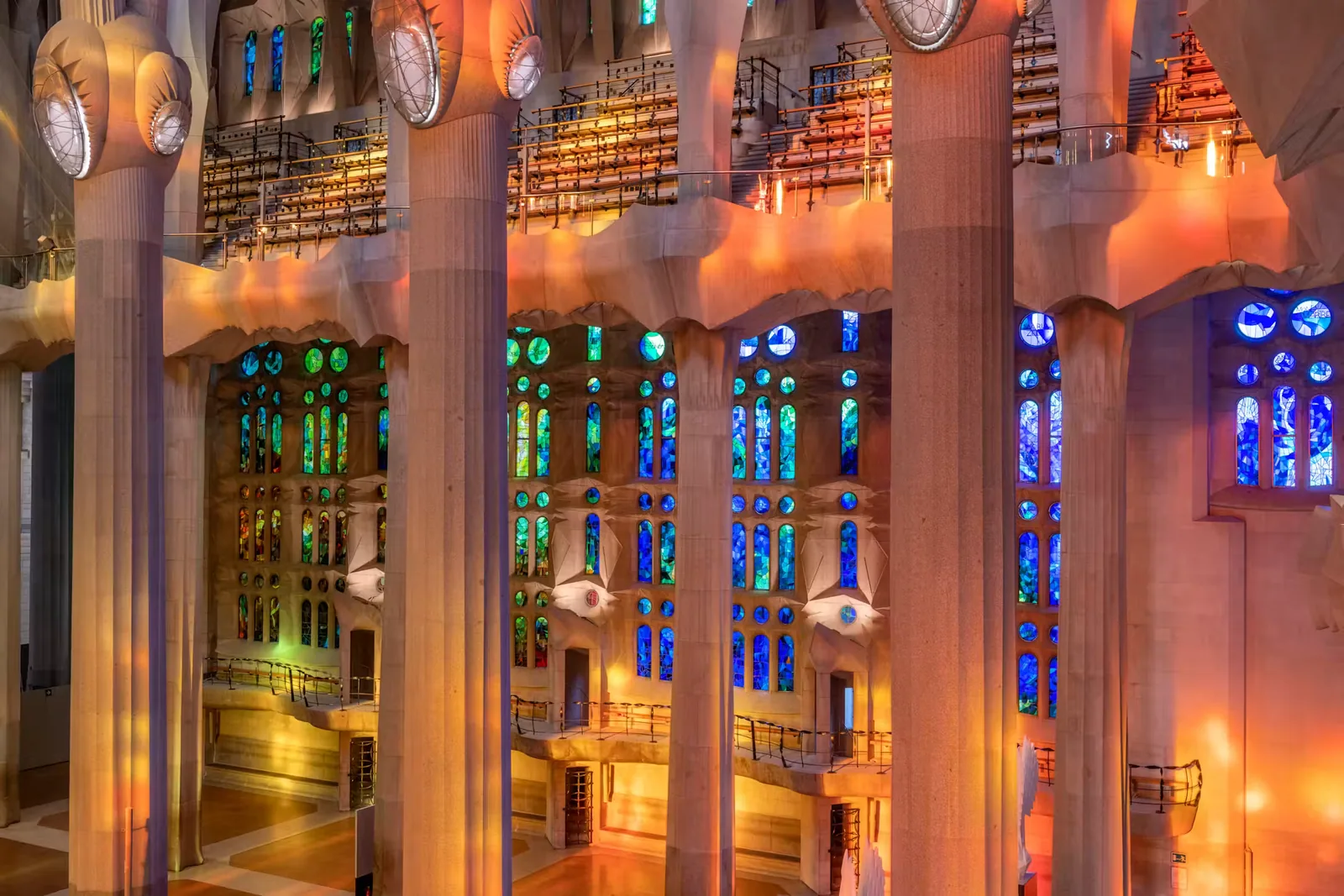
Give the nave your freshest attention. Columns rise and branch like trees, creating long views without the heavy walls of a traditional Gothic church. Light is part of the architecture: cooler colours gather on the Nativity side and warmer tones on the Passion side. Pause in more than one place—the balance of colour, stone and space changes as you move.
The towers
Tower access adds a different, more physical experience, but it is not essential to understanding the basilica. Tickets normally cover either the Nativity or Passion side, subject to availability and conditions. Visitors travel up by lift and descend by stairs. Choose a tower for elevated views and close encounters with the architecture; skip it without regret if mobility, heights or time are concerns.
The museum and Gaudí’s models
Do not rush past the museum at the end. Models, drawings and workshop material explain how Gaudí tested structure and geometry. The displays help turn the apparent fantasy of the nave into something readable: a building developed through observation, calculation and repeated physical experiments.
Nativity Tower or Passion Tower?
Both options add a physical, close-up encounter with the basilica. The better choice depends on availability and what matters most to you.
Nativity Tower
Our first choice for Gaudí fans. The Nativity Façade was the first façade built and the one developed most directly under Gaudí’s supervision. A tower visit brings you closer to the richly modelled architecture that best connects the basilica to his lifetime.
Passion Tower
A compelling alternative if this side is available for your date. The Passion Façade creates a deliberately severe counterpoint to the joyful Nativity side and shows how later artists interpreted Gaudí’s dramatic conception.
Planning your Sagrada Família visit
Sagrada Família opening hours
November–February
Monday–Saturday · 09:00–18:00
Sunday · 10:30–18:00
March and October
Monday–Friday · 09:00–19:00
Saturday · 09:00–18:00
Sunday · 10:30–19:00
April–September
Monday–Friday · 09:00–20:00
Saturday · 09:00–18:00
Sunday · 10:30–20:00
Special hours can apply for religious services and events. The available booking times shown for your chosen date are the most useful source of truth for planning your visit.
How much time do you need?
Allow 1.5 to 2 hours for the basilica, both completed façades and the museum. Add more time for a guided visit or tower access. Avoid placing another timed attraction immediately afterwards; the visit is far more rewarding when you can stop and look rather than follow the clock.
Best time to visit
An early visit works well if you want to arrive with energy and encounter a more contemplative atmosphere. Later light can intensify the stained-glass colour, but the exact effect changes with weather and season. The best slot is ultimately one that leaves enough time around it.
How to get to Sagrada Família
The basilica is in Eixample. Metro lines L2 and L5 stop at Sagrada Família, making the metro the simplest option from most central neighbourhoods. Individual visitors normally enter on the Nativity Façade side at Carrer de la Marina; follow the entrance instructions on your ticket because access arrangements can change.
Accessibility
The basilica visitor route is accessible for people with reduced mobility, but the towers are not. Tower visits involve a lift up and stairs down. Visitors who need step-free access should choose basilica entry without a tower and check the current assistance and entrance instructions before travelling.
Location and contact
- Address
- Sagrada Família Carrer Mallorca, 401 08013 Barcelona Spain
- Area
- Eixample
- Metro
- Sagrada Família — L2 and L5
- Official Sagrada Família information
- +34 932 080 414
Sagrada Família ticket options
Choose the experience that matches how deeply you want to explore. Standard entry suits independent visitors, while a tower or guided option adds another layer to the architecture and story.
Products, inclusions and available times can change. Compare the live details for your date before paying, especially if a tower, a particular language or cancellation flexibility matters to you.
Standard timed-entry tickets can sell out, especially on popular dates. If the simplest entry option is unavailable, guided visits, tower tickets or combination products may still have places.
| Ticket type | Best for | VisitGaudí advice |
|---|---|---|
| Standard basilica entry | A flexible first visit | Explore independently. Check whether an audioguide is included in the product you select. |
| Basilica + tower | Architecture and elevated views | Adds one tower, subject to availability and operating conditions. You go up by lift and down by stairs. |
| Guided tour | More context and storytelling | A strong choice if you want help reading the façades, symbolism and structure. |
| Guided tour + tower | The most complete visit | Combines expert context with one tower; allow extra time and check the selected language. |
| Combination products | Seeing more of Gaudí’s Barcelona | Can pair the basilica with another landmark or experience. Compare timings and inclusions carefully. |
Independent VisitGaudí guide · Tiqets is an external booking platform. We may earn a commission at no extra cost to you.
How to combine Sagrada Família with other Gaudí landmarks
Sagrada Família works naturally with Park Güell in a focused Gaudí day. If you prefer interiors and decorative craft, continue with Casa Batlló or La Pedrera on Passeig de Gràcia.
Use our Sagrada Família and Park Güell itinerary for the most practical pairing, or see the complete Gaudí in one day route. You can also compare all Gaudí landmarks or review the main options in our Gaudí ticket guide.
Frequently asked questions
Which Sagrada Família ticket should I choose?
Choose standard entry with an audioguide for a flexible first visit. Add a tower for elevated views and a more physical route, or choose a guided visit when expert explanation matters more than moving at your own pace.
Are the towers essential?
No. The nave and façades are the heart of the experience. The towers add unusual views and close-up architecture, but they involve a lift up, stairs down and additional restrictions.
How much time should I allow?
Allow around 1.5 to 2 hours for the basilica, façades and museum. A guided visit or tower ticket can make the visit longer, so avoid booking another timed attraction immediately afterwards.
Can I buy tickets on the day?
Sometimes, but popular time slots can disappear. Booking ahead is the safer choice, especially for weekends, holidays and tower access.
What should I bring?
Bring your charged phone, earphones for app-based audio, and clothing suitable for an active place of worship. Check the current ticket instructions before leaving your accommodation.