Palau Güell
An early Gaudí city palace where stone, iron, music and vertical space create a darker kind of spectacle.
Antoni Gaudí built Palau Güell for the industrialist and arts patron Eusebi Güell between 1886 and 1890. Hidden just off La Rambla in Barcelona’s old city, it feels more enclosed and atmospheric than Casa Batlló or Casa Milà. For visitors who want to understand how Gaudí’s mature ideas began, its carriage entrance, subterranean stables, soaring central hall and sculptural rooftop form an essential early chapter.
Palau Güell at a glance
- Location
- Carrer Nou de la Rambla, 3–5 · Barcelona
- Area
- El Raval · Ciutat Vella
- Recommended visit
- Approx. 1–1.5 hours
- Advance booking
- Recommended for a preferred time
- Built
- 1886–1890
- Architect
- Antoni Gaudí
- Commissioned by
- Eusebi Güell
- UNESCO
- Part of the Works of Antoni Gaudí since 1984
- Best known for
- Central hall, basement stables and rooftop chimneys
- Opening hours
- Seasonal; closed on most Mondays — View opening hours ↓
- Tickets
- General admission, selected guided visits and combination products — View ticket options ↓
- Accessibility
- Partially adapted route; roof, mezzanine and south terrace excluded — Read accessibility details ↓
About Palau Güell
Palau Güell is a purpose-built urban palace: a family home that also had to receive business contacts, political guests, musicians and members of Barcelona society. Gaudí fitted those public and private roles into a tight plot in El Raval, organising rooms around a central hall rather than spreading them across a wide site.
That constraint explains much of the experience. The street façade is severe, the lower levels are weighty and the route repeatedly turns inward. Light, air and movement are carefully controlled until the building finally opens above the city on the roof.
The history of Palau Güell
Eusebi Güell was an industrialist, politician and active patron of arts and culture. He commissioned the young Gaudí in 1886 to create a residence for himself, his wife Isabel López and their large family, as well as the household staff. It also needed ceremonial rooms capable of expressing the family’s status and supporting concerts, worship and social gatherings.
Much of the palace was ready for the 1888 Barcelona Universal Exposition, when Güell received prominent visitors, and construction continued until 1890. Gaudí solved the narrow urban site as a sequence: carriages entered directly from the street, horses descended to the basement, guests moved upward to reception rooms and family life occupied more private levels around the great central volume.
The Güell family lived here from 1888. In 1945, Eusebi and Isabel’s youngest daughter, Mercè Güell i López, donated the palace to Barcelona Provincial Council on the condition that it be preserved and used for cultural purposes. Palau Güell was included in UNESCO’s original 1984 inscription of Gaudí works.
Gaudí and Eusebi Güell
Güell gave Gaudí something rare at the beginning of an architect’s career: a demanding commission, significant resources and room to experiment. Palau Güell demonstrates the trust between them. Practical systems, expensive materials, religious symbolism, music and radical spatial ideas were developed as parts of a single home rather than separate decorative gestures.
Their collaboration continued in projects including the Güell Estate pavilions, the church at Colònia Güell and, most famously, Park Güell. The palace makes that later work easier to understand: the patron was not simply buying an unusual style, but supporting a long architectural conversation.
Why does Palau Güell feel so different from Gaudí’s later buildings?
Palau Güell belongs to the dense old city, not the wider avenues and apartment blocks of the Eixample. Gaudí had little street frontage and limited room for courtyards, so he concentrated the architecture vertically. The result feels compressed at the edges and unexpectedly tall at its centre.
Stone from Güell’s Garraf quarries, dark timber and elaborate ironwork establish a serious atmosphere. Even the façade is relatively restrained compared with the later colour and curves of Casa Batlló. Inside, drama comes from procession, changing ceiling heights and filtered light rather than bright surfaces alone.
The mature Gaudí is already present in experimental arches, integrated furniture and craft, ingenious ventilation and roof elements treated as architecture. What changes later is the outward expression: at Casa Batlló and Casa Milà, structure and movement become far more visible from the street.
What to see at Palau Güell
The entrance and iron gates
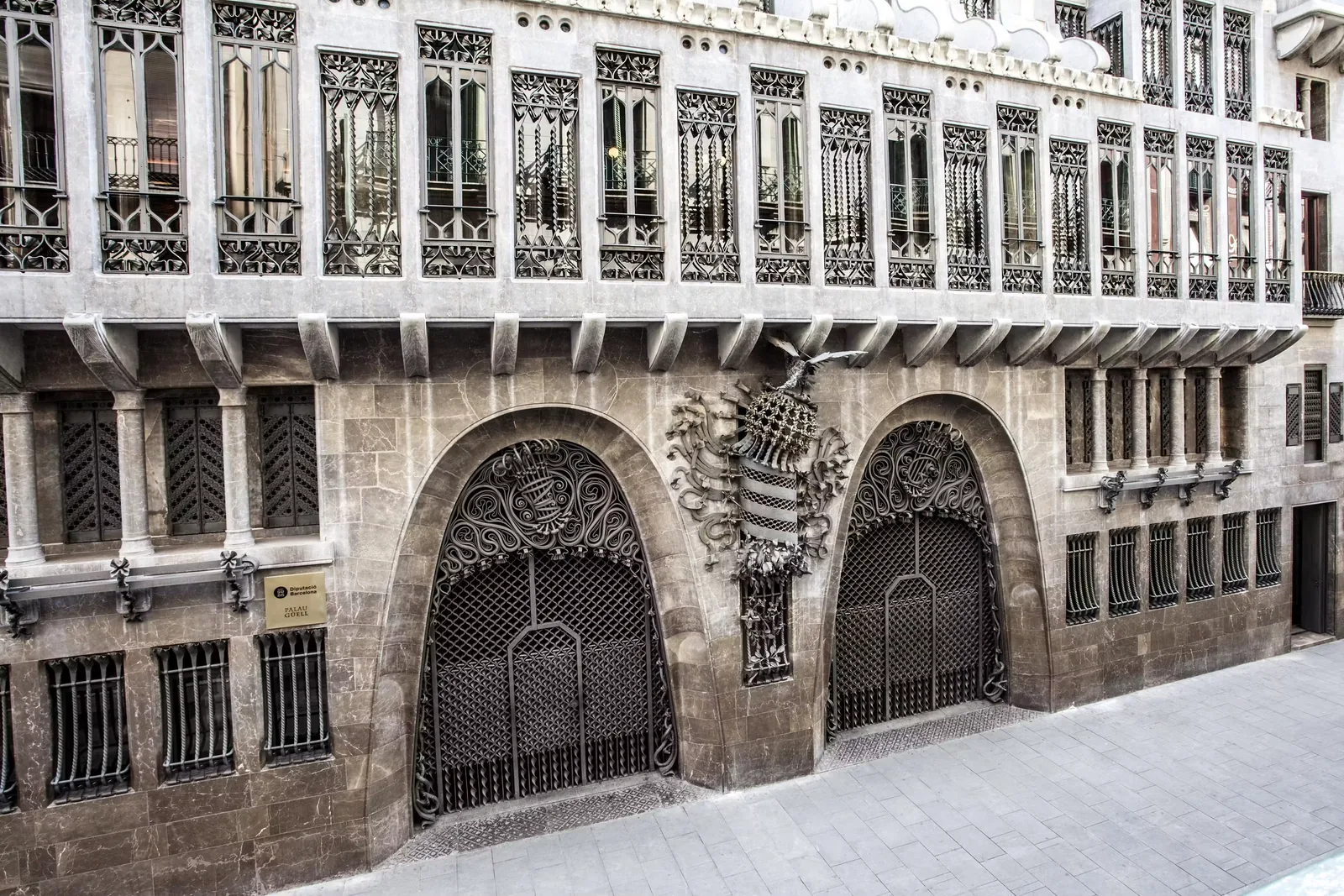
The twin parabolic arches allowed a driver to enter through one gate and leave through the other without reversing. Their wrought-iron screens offered privacy while letting the household see who had arrived. Look for the dense central ironwork and the initials associated with Eusebi Güell.
The coach house and circulation
The ground floor was designed around movement rather than as a conventional entrance hall. Carriages, horses, guests and family members each followed carefully controlled routes through ramps, stairs and reception spaces.
The main rooms
On the principal floor, reception and family rooms surround the central hall. Materials and decoration shift with each room: carved wood, stone, stained glass, metalwork and furniture distinguish formal entertaining from more intimate family life.
The chapel and organ
The central hall could be adapted for worship by opening the chapel doors, while an organ supported music in the house. These elements reveal how Gaudí designed one vertical room to serve several aspects of Güell family life.
The bedroom floor
The upper family rooms are quieter and more domestic. A permanent furniture display in the children’s rooms helps explain the original interiors and the broader world of Catalan Modernisme.
The basement and stables
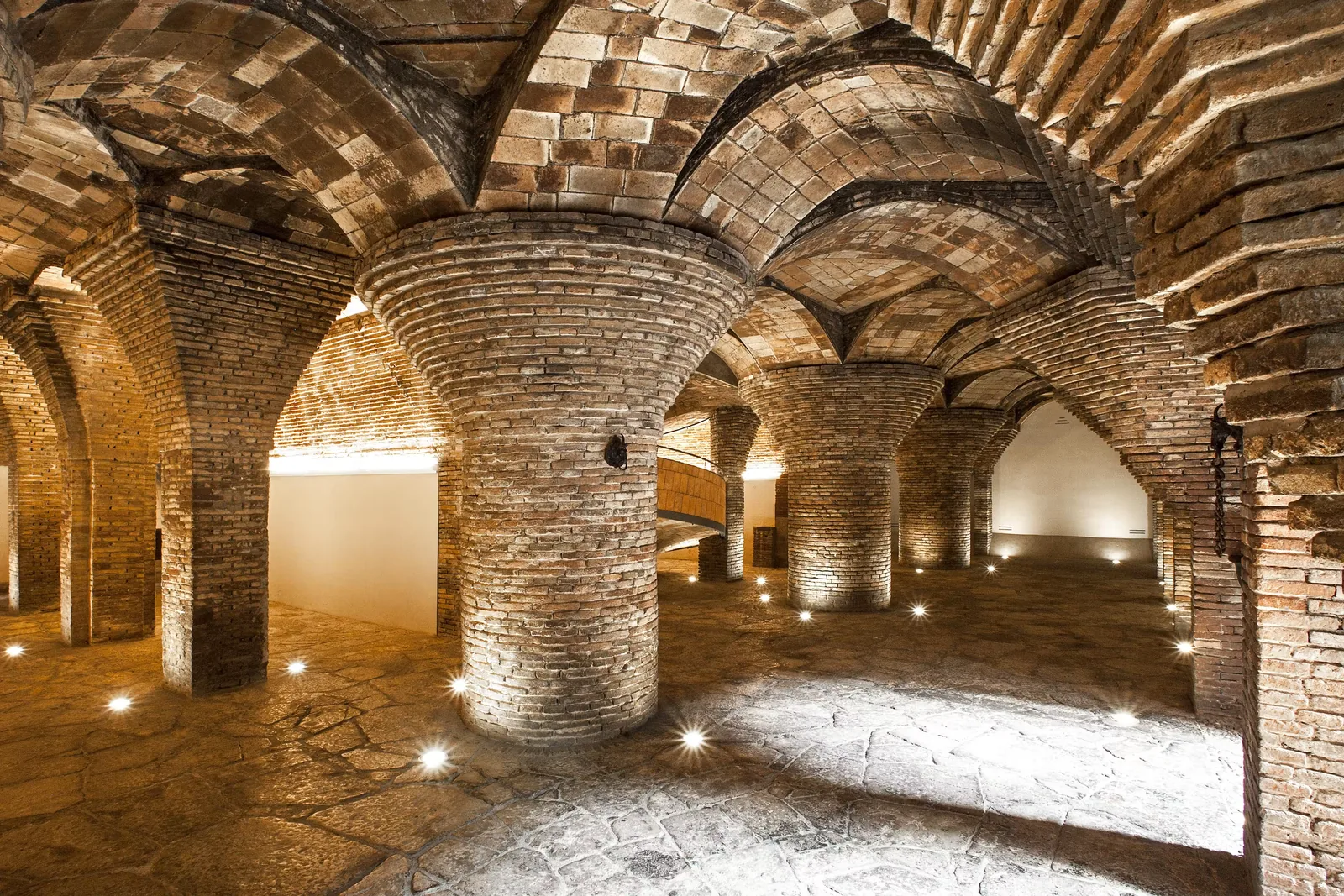
Horse-drawn carriages entered through the façade’s two large arches. While guests continued into the palace, horses were led down a gentle spiral ramp to the basement stables. The route separated service movement from the formal life above and solved a practical problem within very little space.
The basement is not treated as leftover infrastructure. Broad brick pillars support low Catalan vaults, creating a robust, almost subterranean hall with tethering points and carefully planned ventilation. Its repeated arches show the young Gaudí making structure expressive even where few guests would originally have looked.
The central hall
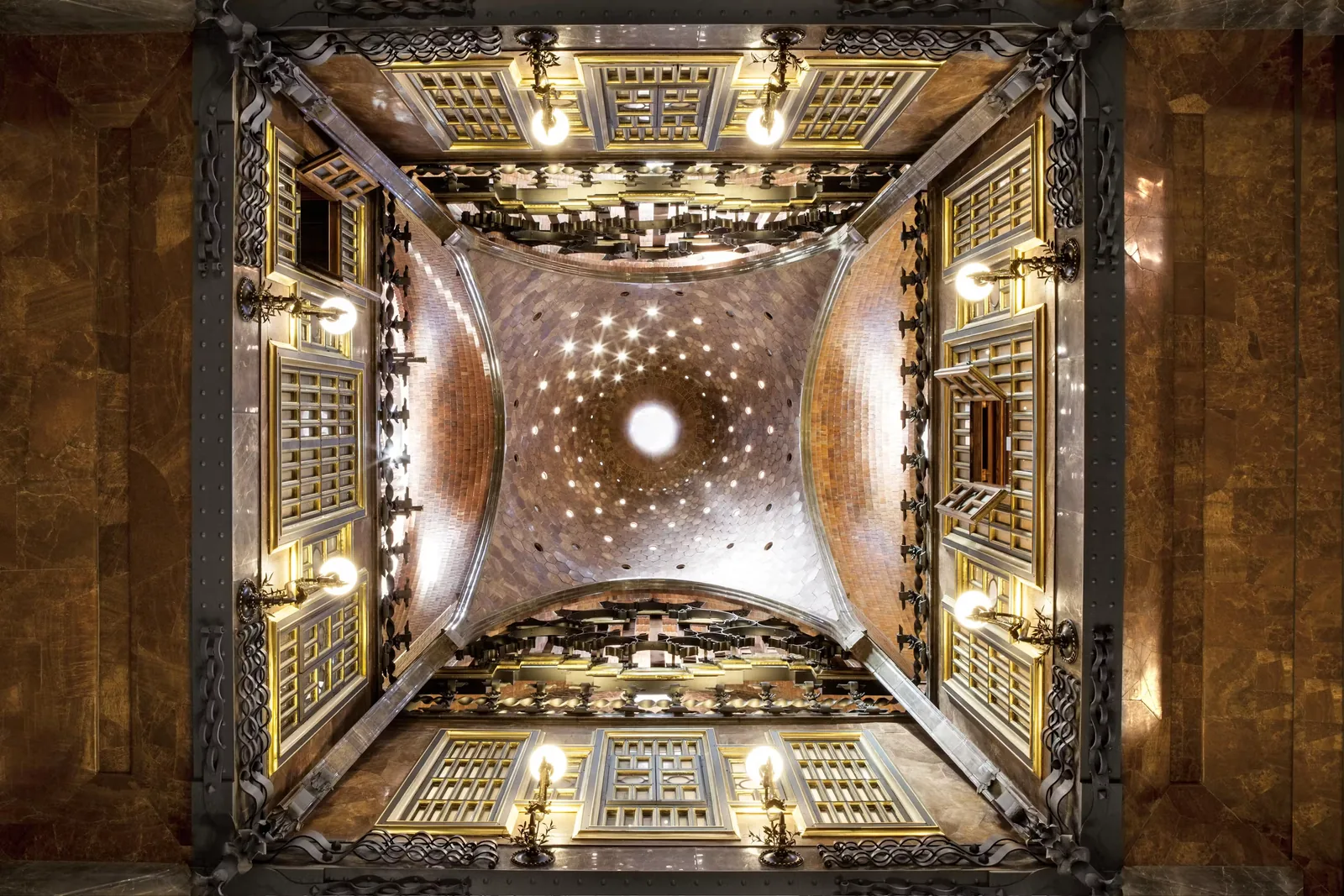
The central hall is Palau Güell’s organising space. It rises through several levels, allowing surrounding corridors and rooms to look into it while giving the narrow palace a sense of height that the street façade does not reveal. A perforated dome admits small points of daylight high above the darker interior.
This was also a working ceremonial room. The Güell family used it for receptions and music, with an organ built into the architecture. Opening the small chapel transformed the same hall for worship. Stand at more than one level to understand how Gaudí connected social display, sound, light and circulation around a single vertical volume.
The rooftop and chimneys
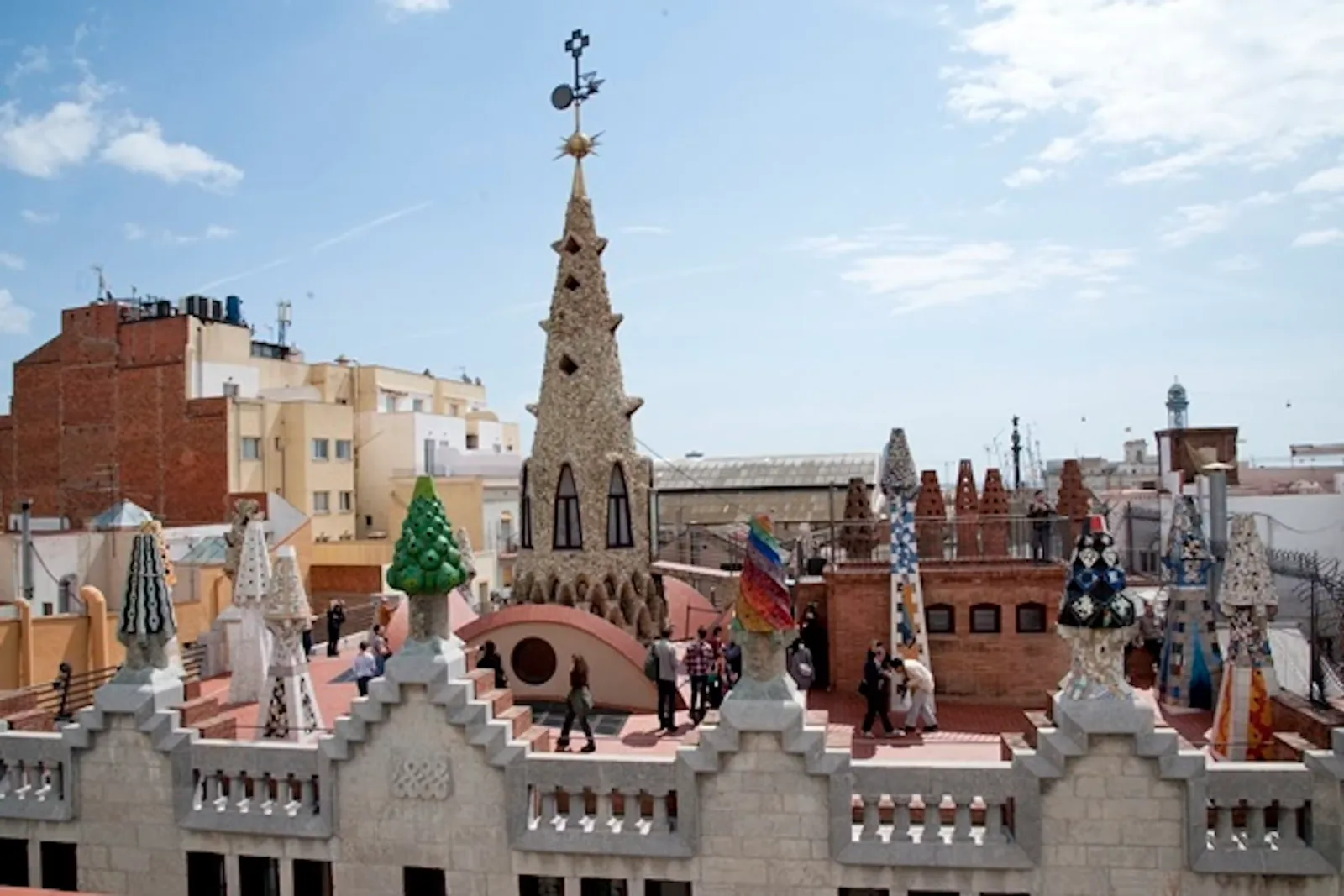
The roof is the palace’s release into light and colour. After the compressed street entrance and dark interior, the route opens to city views around the central spire above the hall. Chimneys and ventilation structures rise as distinct sculptural forms rather than disappearing as utilities.
This is an early example of an idea Gaudí developed throughout his career: necessary roof elements can shape a complete architectural landscape. Varied profiles, brick, stone, ceramic and glass anticipate the more expansive rooftops of Casa Batlló and Casa Milà. Access can close during rain, strong winds or extreme heat, so treat the roof as an important but weather-dependent part of the visit.
Is Palau Güell worth visiting?
Palau Güell is especially rewarding for Gaudí enthusiasts, architecture lovers and repeat Barcelona visitors. Its appeal is not instant colour at every turn. It lies in the contrast between working stables and ceremonial rooms, the controlled ascent through a difficult site and the sudden transformation of chimneys into sculpture above the old city.
If this is your first visit to Barcelona and you have only one or two Gaudí slots, prioritise Sagrada Família and either Park Güell or one house on Passeig de Gràcia. Add Palau Güell when you want a quieter, more concentrated work that explains how Gaudí reached those later landmarks. Its central location and 1–1.5-hour visit make that easier than its lower profile suggests.
Palau Güell, Casa Batlló or Casa Milà?
Choose Palau Güell if…
You want early Gaudí, a dark and atmospheric city palace, and the striking contrast between basement, central hall and rooftop. It offers the most intimate architectural experience of the three.
Choose Casa Batlló if…
You want colour, flowing forms and a polished immersive visitor experience. Casa Batlló is the most theatrical expression of Gaudí’s mature residential design.
Choose Casa Milà if…
You want the largest and most structural visit, with courtyards, an apartment, a catenary-arched attic and an extensive sculptural rooftop.
For a first house interior, Casa Batlló is the easiest emotional choice. For architecture and rooftop design, Casa Milà is strongest. For Gaudí’s development, atmosphere and fewer obvious comparisons, Palau Güell is the more revealing choice.
Planning your Palau Güell visit
How much time do you need at Palau Güell?
A focused visit can take about one hour. Most first-time visitors should allow 1 to 1.5 hours for the audioguide, basement, principal rooms, central hall and rooftop. Architecture enthusiasts may want closer to two hours to study the ironwork, spatial connections and furniture without rushing.
Best time to visit Palau Güell
Morning is useful if you want to explore the palace before La Rambla and the old city become busier. A later visit can give the rooftop warmer light, but leave enough time before last admission to complete the full route. Because the roof is weather-dependent, do not choose a time solely for the view.
Palau Güell opening hours
1 April–31 October: 10:00–20:00, with last admission at 19:00. 1 November–31 March: 10:00–17:30, with last admission at 16:30.
The palace is closed on non-holiday Mondays, 1 and 6 January, 25 and 26 December and its annual maintenance week in late January. Special dates can alter the schedule, so the available entry times for your chosen date remain the final check.
Location and how to get there
Palau Güell is at Carrer Nou de la Rambla, 3–5, in El Raval, a few steps from La Rambla. Liceu station on metro line L3 is the closest convenient stop. The entrance sits on a narrower side street, so look for the twin iron arches rather than expecting a broad plaza.
Accessibility
The palace offers a partially adapted route using a small lift. Visitors with reduced mobility can reach the spaces on the regular route except the roof, mezzanine and south terrace. The official accessibility information lists a lift-door width of 60 cm and interior depth of 78 cm.
A wheelchair sized for the lift is available to borrow, and staff can assist with transfers and the route. There is an adapted toilet on the ground floor, seating along the visit and support for visual and hearing needs. The basement stables and rooftop are not accessible to wheelchair users.
Palau Güell tickets explained
The current offer is simpler than at Barcelona’s larger Gaudí attractions. General admission includes the regular route and audioguide. Selected weekend guided visits are part of the official programme, while Tiqets currently also lists the wider Gaudí–Güell Pass and changing hand-picked combinations.
Our default: For most first-time visitors, general admission with the included audioguide is sufficient. Choose a weekend guided visit when you want more context about Gaudí’s early architecture and his relationship with Eusebi Güell.
| Ticket type | Best for | VisitGaudí advice |
|---|---|---|
| General admission | Most first-time visitors | Includes the regular visitor route and an audioguide. This is the clearest default choice; bring earphones if you plan to use the guide on your own phone. |
| Weekend guided visit | More context at no extra tour charge | The official programme currently schedules guided visits in selected languages on Saturdays and Sundays, included with admission. Places, languages and times are limited and may need the venue’s own booking channel. |
| Gaudí–Güell Pass | A wider Güell-focused itinerary | The current Tiqets combination includes Palau Güell, the Colònia Güell Crypt and Park Güell. Check travel time and each included entry slot before choosing it. |
| Hand-picked combinations | Pairing Palau Güell with another Barcelona attraction | Tiqets may offer changing two-attraction bundles. Compare what is included rather than assuming every combination contains the same Palau Güell admission. |
Capacity is limited and preferred times can fill. Booking ahead is recommended when Palau Güell must fit a fixed old-city itinerary. Compare another entry time before rebuilding the rest of your itinerary.
Independent VisitGaudí guide · Tiqets is an external booking platform. We may earn a commission at no extra cost to you.
What can you combine with Palau Güell?
La Rambla, the Gothic Quarter and the waterfront are the easiest companions because no extra timed attraction is required. After the palace, cross La Rambla for Plaça Reial, continue into the Gothic Quarter or walk south toward the Columbus Monument and Port Vell. This gives the visit its old-city context instead of treating it as an isolated stop.
If you want another Gaudí landmark later, Casa Batlló and Casa Milà are straightforward to reach by metro or on foot with a longer city walk. Casa Vicens offers the most useful early-career comparison, while Sagrada Família or Park Güell creates a stronger contrast. Leave a real break between timed entries; the Gaudí in one day guide can help keep the route realistic.
Frequently asked questions
What is Palau Güell?
Palau Güell is an urban family palace designed by Antoni Gaudí for Eusebi Güell. Built between 1886 and 1890 near La Rambla, it combined private family life with business, cultural and ceremonial entertaining.
Who was Eusebi Güell?
Eusebi Güell was a Catalan industrialist, politician and patron of arts and culture. His long relationship with Gaudí enabled major experiments at Palau Güell and later projects including Park Güell and the church at Colònia Güell.
Why is Palau Güell important in Gaudí’s career?
It was one of Gaudí’s first major commissions and already combines structure, craft, symbolism, movement and rooftop sculpture. Many ideas that became more visible in his later buildings are tested here in an unusually constrained city site.
Is Palau Güell worth visiting?
It is particularly rewarding for Gaudí enthusiasts, architecture lovers and repeat Barcelona visitors. First-time visitors with only one or two landmark slots may prefer Sagrada Família or Park Güell, but Palau Güell offers a more intimate and atmospheric early work.
How long do you need at Palau Güell?
Allow about 1 to 1.5 hours for a typical first visit. A focused route can take around an hour, while architecture enthusiasts may want closer to two hours for the audioguide, basement, rooms and roof.
Which Palau Güell ticket should I buy?
For most visitors, general admission with the included audioguide is sufficient. Choose a weekend guided visit when the available language suits you, or the Gaudí–Güell Pass if you are realistically planning all three included sites.
Do Palau Güell tickets include an audioguide?
The regular visit currently includes an audioguide. The official visitor guidance recommends bringing headphones when using the tour on your own mobile device.
What should you see inside Palau Güell?
Give priority to the carriage entrance, basement stables, principal rooms, central hall and its dome, then the rooftop chimneys. Together they explain how Gaudí organised movement, light, entertaining and service in a compact palace.
Is the Palau Güell rooftop worth seeing?
Yes. It provides the visual release after the darker interiors and shows Gaudí turning functional chimneys and ventilation elements into sculpture. The roof can close during rain, strong wind or extreme heat.
Is Palau Güell accessible?
There is a partially adapted route using a small lift. It reaches the regular spaces except the roof, mezzanine and south terrace. The lift door is 60 cm wide and a compatible wheelchair can be borrowed; staff assistance and an adapted ground-floor toilet are available.
Palau Güell, Casa Batlló or Casa Milà—which is best?
Choose Palau Güell for early Gaudí, atmosphere and a city-palace interior; Casa Batlló for colour and theatrical immersion; or Casa Milà for structural ideas, apartment planning and the most extensive rooftop experience.
Where is Palau Güell?
It is at Carrer Nou de la Rambla, 3–5, in El Raval, only a short distance from La Rambla and Liceu metro station on line L3.